


Protecting Your Kitchen Garden and Home: What You Need to Know About Pest Prevention Costs
If you spend your weekends tending basil pots on the patio or nursing a backyard tomato bed toward its first ripe fruit, you already know how quickly a healthy harvest can turn into a disappointment. Aphids, squash bugs, and rodents looking for an easy meal do not care how many hours you put into your kitchen garden, and the same pests that nibble your herbs often find their way indoors through gaps around doors and windows. For home cooks who take pride in growing what they cook, pest pressure is not just a nuisance, it is a direct threat to the ingredients you were counting on for dinner.
That overlap between garden and kitchen is exactly why pest prevention deserves the same practical, cost-conscious thinking you already apply to meal planning or stocking a pantry. Understanding what you are actually paying for, and why, helps you avoid both overspending on unnecessary treatments and underspending in ways that let a small problem become an expensive one. The GreenShield Home & Pest Solutions team often hears from homeowners who want a clear-eyed breakdown of costs before they commit to a service plan, and that clarity is worth building before pests show up uninvited.

Understanding Pest Prevention Costs: What Homeowners Actually Pay
Pest control pricing varies more than most people expect, largely because it depends on the type of pest, the severity of the problem, and how often treatment is needed. A single visit for a minor ant or spider issue might run on the lower end, while a more invasive infestation requiring specialized equipment pushes costs higher. According to This Old House, most homeowners spend somewhere between $50 and $500 per visit for professional pest control, with the final number shaped by pest type, infestation severity, treatment frequency, and regional factors. That range is wide on purpose, since a quick inspection and a full-scale treatment for an established problem are simply not comparable jobs.
It also helps to know that pest control pricing has been creeping upward for years, not because companies are padding margins, but because labor costs and product formulations have both become more sophisticated. Industry data suggests annual increases of roughly 3 to 5 percent over the past decade, a trend worth factoring in if you are budgeting multiple years out. Treating pest prevention as a predictable, recurring household expense rather than a one-time emergency fix tends to save money over time.
Where Your Pest Prevention Budget Goes: Breaking Down Service Types and Pest Categories
Most pest control spending falls into a few recognizable categories: one-time visits, monthly plans, quarterly plans, and specialized treatments for pests like termites. One-time visits make sense for an isolated issue, such as a wasp nest near the porch or a single rodent sighting, but they do not offer ongoing protection. Monthly and quarterly plans build in regular inspections and barrier treatments, which matter more for gardens and homes in areas with heavy seasonal pest activity. Termite treatment sits in its own category entirely, since the cost of localized treatment versus full fumigation can differ by thousands of dollars depending on how far an infestation has spread.
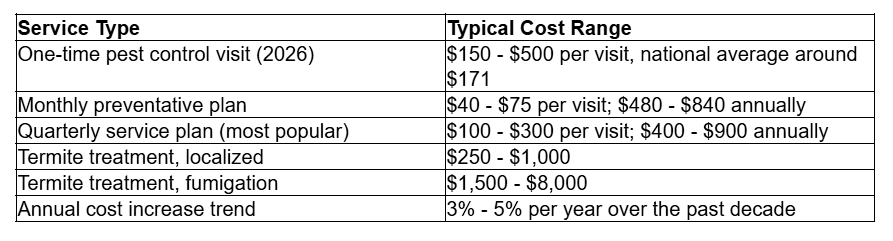
Looking at the table, quarterly plans tend to offer the best middle ground for most households, balancing cost against consistent coverage. Monthly plans make more sense for properties with chronic pressure, such as homes near wooded lots or gardens that have struggled with recurring insect damage. Termite treatment costs stand apart because the stakes are structural, not just cosmetic, which is why that category commands a much wider price spread.
Smart Spending: High-ROI Prevention Measures vs. Where You Can Economize
Not every dollar spent on pest prevention delivers the same return. Sealing entry points, maintaining proper drainage away from the foundation, and keeping garden beds free of decaying plant matter are low-cost steps that significantly reduce the chance of an infestation taking hold in the first place. These measures cost little beyond your own time and attention, yet they often prevent the kind of severe problem that would otherwise require an expensive emergency visit. On the other hand, some homeowners overspend on broad-spectrum treatments applied preemptively across an entire property when a targeted approach to known problem areas would accomplish the same goal for less.
Where it makes sense to spend more is on professional inspections for pests that cause structural or long-term damage, since termites and carpenter ants are not problems you want to discover late. A quarterly plan that includes inspection, not just spraying, tends to justify its price by catching small issues before they become costly ones. If you are also investing time and money into a productive kitchen garden, it is worth remembering that the same budget mindset applies there too, whether you are deciding what to plant next season or how to use what you grow, much like the seasonal planning you might find when you browse recipes built around fresh garden produce.

Professional vs. DIY: Making the Cost-Effective Choice for Your Kitchen Garden and Home
DIY pest control has its place, particularly for minor, isolated issues like a few ants near a windowsill or aphids on a single plant. Store-bought traps and sprays are inexpensive and can handle small-scale problems without much fuss. But DIY approaches tend to fall short with pests that reproduce quickly, hide in wall voids, or require precise application, since an incomplete treatment can actually make an infestation harder to eliminate later by scattering the colony rather than removing it.
Professional service earns its cost through expertise, equipment, and the kind of follow-up inspection that catches recurring activity before it spreads. For homeowners juggling a kitchen garden alongside the rest of the house, the real value of professional pest prevention is peace of mind paired with fewer surprises at harvest time. Weighing the numbers honestly, a modest quarterly plan often costs less over a year than the cumulative expense of repeated DIY products that only partially solve the problem, which makes it one of the more straightforward cost comparisons in home maintenance.